Does a fence need building consent?
Not if it is ≤ 2.5 m high, unless it is a pool fence.
- Building Act 2004

One clause of Schedule 1, measured by height.
Schedule 1 of the Building Act lists the work that needs no building consent. Clause 21 covers fences and hoardings by their height, and leaves out a fence that restricts access to a residential pool.
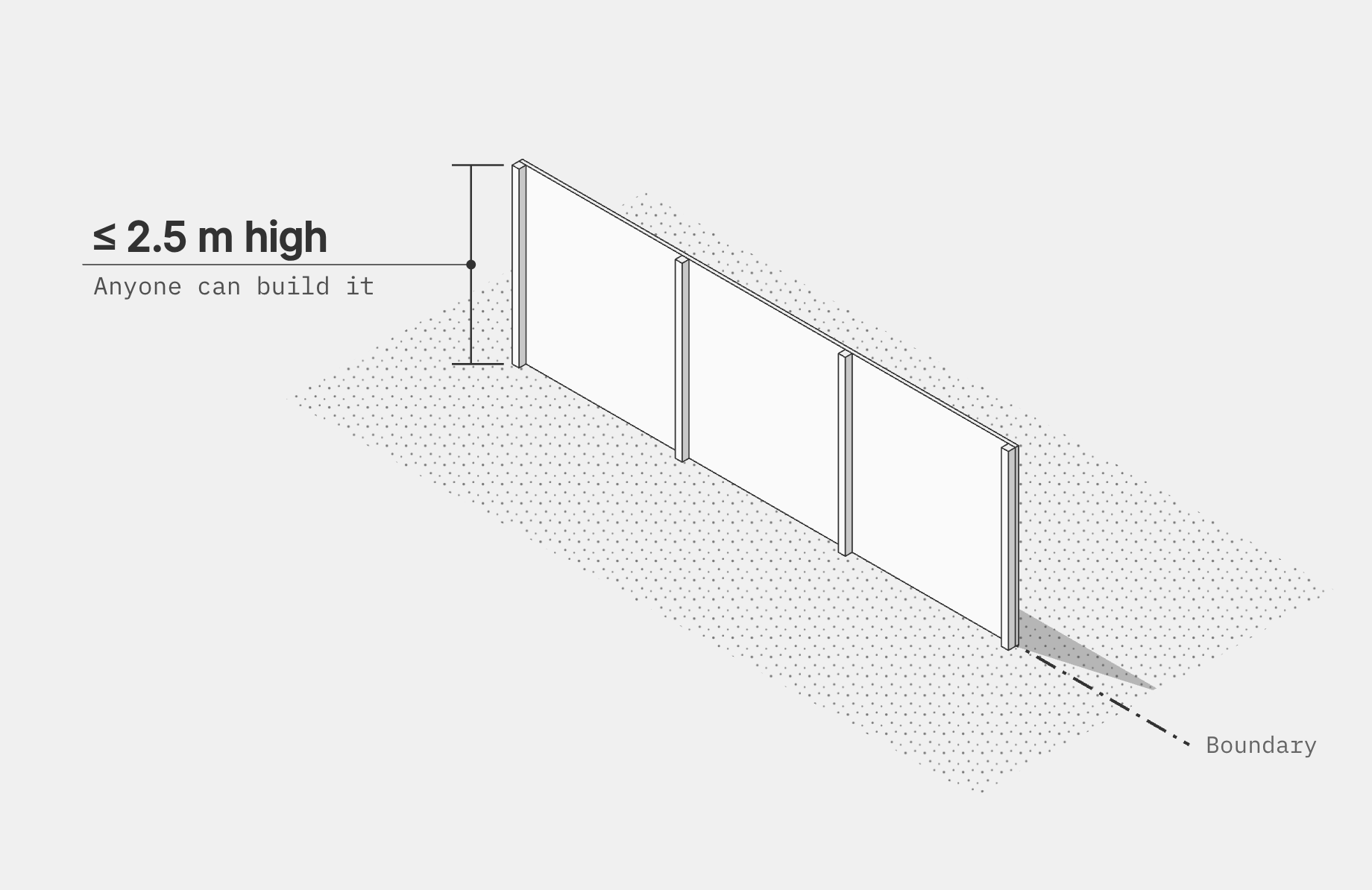
The height, not the length or the material, decides.
MBIE's examples: a 2 m concrete block wall on a boundary, a 2.2 m paling windbreak and a 2.4 m hoarding round a building site need no consent. A 2.8 m block wall, a 3 m timber fence and a 3.5 m mesh fence round a tennis court each need one.
Building Act 2004 Schedule 1 clause 21 · MBIE, exempt building work guidance 9.1
A block wall along a boundary counts as a fence.
These are how MBIE reads the exemption in its guidance: its examples include a concrete block wall, a paling fence, mesh fencing and a construction hoarding.
MBIE, exempt building work guidance 9.1
The pool barrier is the one fence the Act always checks.
MBIE's example: a new 1.2 m fence round a swimming pool needs a building consent, goes up before the pool is filled with water, and is inspected every three years from its code compliance certificate.
Building Act 2004 Schedule 1 clauses 21(2), 23(2) · MBIE, exempt building work guidance 9.1
Check these before you build.
All building work must meet the Building Code, consent or not, and the owner answers for it. MBIE's notes for fences name the Fencing Act 1978 for a boundary fence, and district plans that often ask a resource consent for a fence > 2 m.
Building Act 2004 ss 14B, 17 · MBIE, exempt building work guidance 9.1
Key takeaways
- A fence or hoarding ≤ 2.5 m high needs no building consent. > 2.5 m: a building consent.
- Measure from the top of the fence to the ground directly below it.
- A pool fence is never exempt. A boundary fence is under the Fencing Act 1978 too.